

Table of Contents
- What to Look for in Compact Air Purifiers for Small Bedrooms
- How to Choose an Air Purifier for Small Rooms
- Quiet Air Purifiers for Sleeping: Decibel Levels and Sleep Mode
- Placement Optimization for Airflow in Small Bedrooms
- Ozone Emission Safety and Energy Efficiency
- Long-Term Cost of Ownership for Compact Air Purifiers
- Frequently Asked Questions
Last Updated: September 14, 2026
What to Look for in Compact Air Purifiers for Small Bedrooms
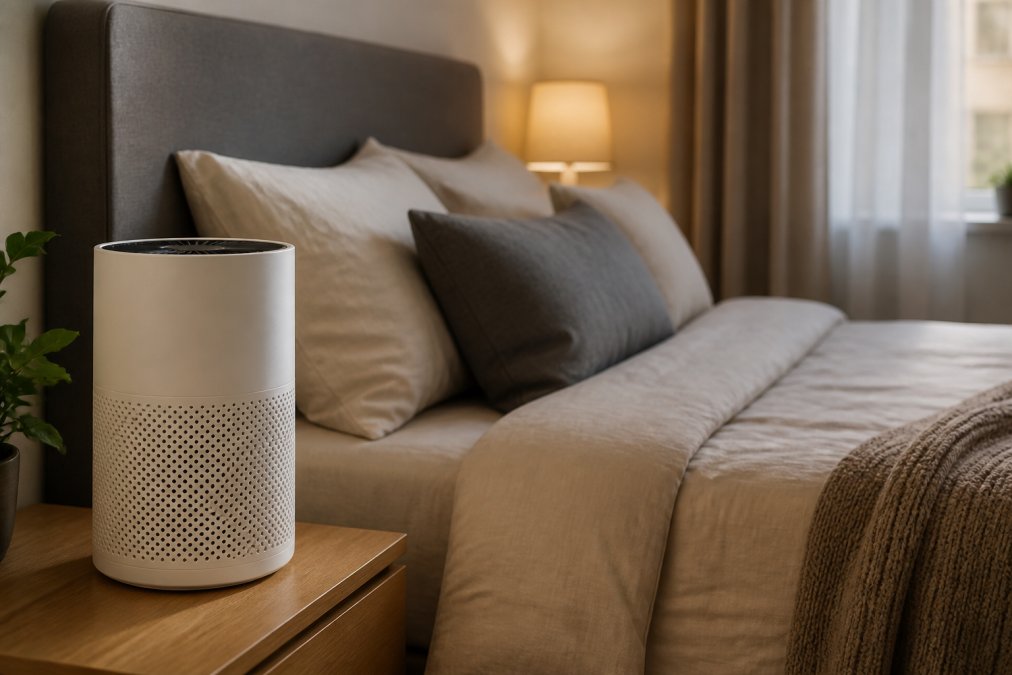
Compact air purifiers for small bedrooms solve a specific problem: cleaning the air in a tight space without eating up floor area or generating noise that keeps you awake. According to the EPA's indoor air quality guidance, indoor pollutant concentrations can run two to five times higher than outdoor levels, which makes a properly sized unit genuinely useful in a sealed bedroom.
Most buyers over-index on filtration claims and under-index on the three things that decide whether a purifier works in a bedroom: airflow matching, noise at the speed you'll actually run, and placement. Get those wrong and even a well-built unit disappoints.
CADR Ratings and Square Footage Coverage
CADR (Clean Air Delivery Rate) is the volume of filtered air a purifier delivers per minute, measured in cubic feet per minute (CFM). It's the most useful spec on the box because it combines airflow and filtration efficiency into one number. A unit rated at 100 CFM for smoke moves meaningfully more clean air than one rated at 60.
Match CADR to room volume, not just floor area. A 10 ft x 10 ft bedroom with an 8 ft ceiling holds 800 cubic feet. A rough rule many manufacturers use is a smoke CADR at least two-thirds of the room's square footage for standard ceilings; for a 100 sq ft room, that's around 65 or higher. Low ceilings or heavy furniture reduce effective volume, so treat the number as a floor, not a target.
HEPA Air Purifier for Bedroom Use: Why Filtration Type Matters
A true HEPA air purifier for bedroom use captures 99.97% of particles at 0.3 microns, covering pollen, pet dander, and most airborne particulate matter (the EPA). Cheaper "HEPA-type" or "HEPA-like" labels aren't held to that standard, and the difference shows up in particulate matter readings over weeks, not minutes.
Look for a pre-filter plus activated carbon layer alongside the HEPA media. The pre-filter catches hair and larger debris so the HEPA layer lasts longer, and activated carbon handles VOCs and odors HEPA alone won't touch. A filter replacement indicator removes the guesswork, which matters because a clogged filter quietly drops airflow and CADR together.
How to Choose an Air Purifier for Small Rooms
Most buying guides hand you a spec sheet and tell you to trust it. That's backwards. You can run a stripped-down version of the same testing process in a showroom or your own bedroom before you commit. Here's the sequence that separates a purifier that works in a small bedroom from one that just looks good on paper.
Step 1: Measure the room, then discount it
Measure length x width x ceiling height in feet to get cubic volume. A 10 ft x 10 ft bedroom with an 8 ft ceiling is 800 cubic feet. Now discount it: a bed, dresser, and closet doors eat usable air volume, and a closed door with no return vent means the unit recirculates the same pocket of air. A furnished small bedroom often behaves as 70-80% of its empty volume, so a 100 sq ft room often behaves like an 80 sq ft room. Your CADR target should reflect the smaller number.
Step 2: Set a noise ceiling before you set a CADR target
Decide the loudest fan speed you can sleep through, then find the highest CADR the unit delivers at or below that speed. A unit rated at 200 CFM on turbo is useless if turbo sounds like a box fan and you'll only ever run it on low. The practical test: run the unit on its lowest setting in a quiet room and listen for the fan bearing, motor hum, and any clicking from the display or sensor. Those three sounds wake light sleepers, not the airflow itself.
Step 3: Verify the filter, not the label
Ask three questions about the filter stack:
- Is it true HEPA? True HEPA captures 99.97% of particles at 0.3 microns. "HEPA-type," "HEPA-like," and "99% HEPA" are marketing terms with no fixed standard.
- Is there a separate pre-filter? A washable or replaceable pre-filter catches hair and dust before it reaches the HEPA media, which extends the expensive filter's life. Units without one clog faster.
- Is there real activated carbon? A thin carbon dusting handles odors for weeks. A granular carbon bed handles them for months. If the spec sheet lists carbon weight in grams, higher is better.
Step 4: Do the three-year math before you check out
Add the purchase price to (filter price x replacements per year x 3) plus electricity. A unit with a $40 filter replaced every three months costs $480 in filters alone over three years, which can exceed the purifier's price. A mid-priced unit with a $60 filter that lasts a year costs $180 over the same period. The cheaper sticker price is frequently the more expensive purchase.
Step 5: Confirm placement will actually work
Before buying, find the spot the unit will live in and measure intake-side clearance. Most compact units need 6 to 12 inches of unobstructed space on the intake, and blocking it can cut effective airflow roughly in half. If the only spot is a nightstand pressed against a wall, pick a unit with a front-facing intake or plan to move furniture.
Step 6: Decide what you'll actually verify
The unit's own air quality sensor is a convenience feature, not a measurement tool. To confirm the purifier is doing what you paid for, an independent particulate monitor gives you real PM2.5 and TVOC readings you can compare before and after a filter change, the difference between trusting a green light and knowing the air is clean.

Quiet Air Purifiers for Sleeping: Decibel Levels and Sleep Mode
Quiet air purifiers for sleeping typically land between 20 and 30 decibels on their lowest setting, roughly a soft whisper. A normal conversation sits around 60 decibels and a refrigerator hum about 40.
| Spec | What to check | Why it matters at night |
|---|---|---|
| Lowest fan speed | 20-30 dB | Keeps the unit from waking light sleepers |
| Display lighting | Dim or off in sleep mode | Prevents light-based sleep disruption |
| CADR at low speed | Highest available under 30 dB | Ensures real filtration, not just quiet |
| Timer or auto mode | Adjustable, with air quality sensor | Reduces manual fiddling overnight |
Placement Optimization for Airflow in Small Bedrooms
Aim for these conditions:
Ozone Emission Safety and Energy Efficiency
The safety check almost no buying guide runs
How to check a unit before you buy
Energy efficiency: the smaller, quieter consideration
Long-Term Cost of Ownership for Compact Air Purifiers
Use this framework to estimate three-year cost:
| Cost component | How to estimate it | Watch for |
|---|---|---|
| Purchase price | Listed retail price | Sale pricing that hides filter markup |
| Filters | Filter price x replacements per year x 3 | Proprietary filters with no third-party options |
| Electricity | Wattage x hours used x local rate | High draw at the speed you actually run |
| Replacement unit risk | Probability of failure before year 3 | Short warranties on cheap units |
Frequently Asked Questions
What is the best air purifier for a small bedroom?
The best compact air purifiers for small bedrooms balance three things: a CADR rating matched to your room size, a true HEPA filter, and quiet operation under 30 decibels. Look for units rated for at least 100 square feet with a clean air delivery rate of 100 CFM or higher. A filter replacement indicator and energy-efficient motor also matter for long-term value.
Do mini air purifiers actually work for small spaces?
Yes, compact air purifiers work well in small bedrooms when sized correctly. A unit with a CADR of 100 CFM can filter a 100-square-foot room about four times per hour. The key is matching the unit's capacity to your room volume, not assuming bigger is always better. Desktop units work for very tight spaces but may need higher fan speeds to keep up.
What features should I look for in a compact air purifier?
Prioritize true HEPA filtration, a CADR rating that matches your room's square footage, and a sleep mode that drops noise below 30 decibels. An activated carbon filter helps with odors and volatile organic compounds. A filter replacement indicator saves guesswork. Energy Star certification keeps power costs low, and smart home integration adds scheduling convenience.
How often do I need to replace filters in compact air purifiers?
Most compact air purifiers need a HEPA filter replacement every 6 to 12 months, depending on use and air quality. Pre-filters should be vacuumed every 2 to 4 weeks. If you run the unit daily in a bedroom with pets or high pollen, plan on the shorter end. A filter replacement indicator removes the guesswork and keeps filtration performance steady.
The hard part of buying a compact purifier isn't finding one; it's finding one that fits your actual room, runs quietly enough to sleep through, and doesn't cost a fortune in filters. Shop Home Electronics stocks compact electronics built for exactly these tight-space setups, with free ground shipping on every order, free returns, and member rewards on top. Browse the collection and add to cart when you're ready to breathe easier.